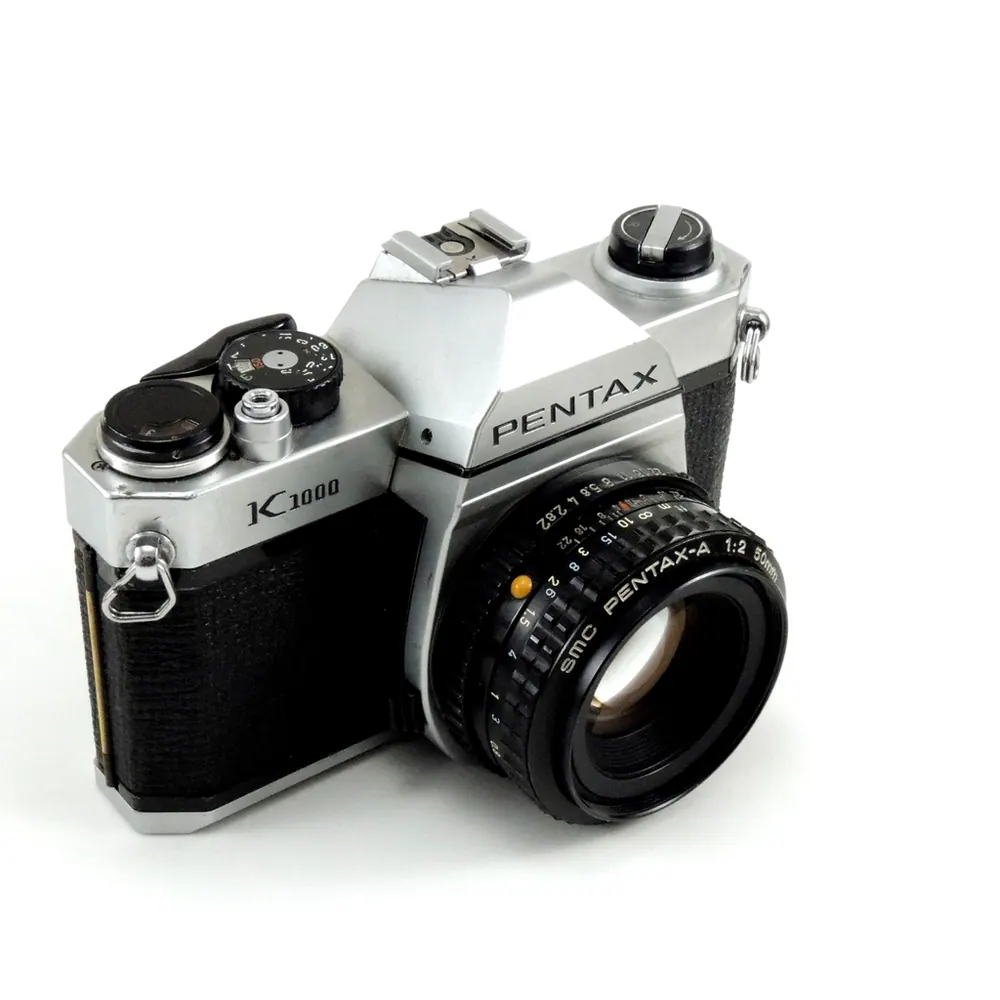
The Asahi Pentax K1000 was introduced in 1976 and made, almost unchanged, until 1997. It has no autofocus, no auto exposure and no program modes — and that is exactly why generations of photography teachers put it in students' hands.
Pentax K1000 at a glance
| Type | 35mm manual-focus SLR |
|---|---|
| Lens mount | Pentax K (bayonet) |
| Shutter | Mechanical cloth focal-plane, 1 s – 1/1000 s + B |
| Flash sync | 1/60 s |
| Metering | Centre-weighted match-needle CdS meter |
| Battery | One LR44/SR44 — for the meter only |
| Made | 1976–1997 (Japan, later Hong Kong and China) |
What the K1000 does brilliantly
- It works without a battery. The shutter is entirely mechanical; the battery only powers the light meter. Run it flat in the mountains and you can keep shooting with the Sunny 16 rule.
- It teaches exposure. A needle in the viewfinder tells you to open up or stop down. You set aperture and shutter speed yourself, so every frame is a small lesson.
- K-mount lenses are everywhere. The SMC Pentax-M 50mm f/1.7 and f/2 are cheap and excellent, and decades of third-party K-mount lenses fit.
- It is built like a tank. A metal body, few electronics, and a simple layout mean there is not much to break.
The quirks
- No depth-of-field preview, no self-timer and no mirror lock-up.
- The meter is always on when the lens cap is off — keep the cap on in your bag to save the battery.
- Later Chinese-made bodies have more plastic parts than the early Asahi versions.
Pentax K1000 photos: what to expect
The K1000 doesn't have a "look" of its own — the lens and film do. With a 50mm f/1.7 and a roll of Kodak Portra 400 you'll get warm, natural skin tones; with Ilford HP5 Plus you'll get classic, punchy black & white. The meter is reliable for average scenes, so watch for backlit subjects and snow.
What to check before buying
- Fire the shutter at 1 s and 1/1000 s: the difference should be obvious.
- Check that the meter needle moves when you point the camera at light and dark areas (with a fresh LR44).
- Look for sticky or crumbling light-seal foam around the back and mirror box.
- Inspect the lens for haze or fungus and make sure the aperture blades are dry and snappy.
Best film for the Pentax K1000
Start with a 400-speed film — Kodak UltraMax 400, Portra 400 or Ilford HP5 Plus — for flexibility indoors and out.
Verdict: is the Pentax K1000 still worth it?
Yes — if you want to learn. The K1000 is honest, durable and simple; nothing gets between you and the exposure. If you'd like aperture-priority automation, look at the Pentax ME Super or Minolta X-700; for a similar fully mechanical experience from Nikon, the Nikon FM.
Relics Film Lab earns from qualifying Amazon purchases made through links in this guide.